The mise en scene denotes the sci-fi genre through cables and computers etc. there is low key lighting in some scenes which further adds to this. The fact that she has dark hair shows that perhaps she is intelligent, if she was blond, her beauty would be more focused on. Her minimal makeup again represents the fact that she is smart. If she was blond/ lots of makeup, it would stick to the stereotype of western beauty. A conscious decision has been made so that looks and glamour have been downplayed to a certain degree. She is very unlike the typical Scream Queen character which is found in the horror genre. It has become the normative to put attractive female actors on screen, in this it could be more heavily stereotyped but it still features. The secondary character's hair is messy and not styled. This is to signify her innocence. There is also the absence of heavy makeup on this character which again shows that she is young/innocent. The mise-en-scene creates verisimilitude in terms of genre through the lighting (neon, blue/green), and also the cables, wires and computers.
Editing:
Continuity editing is used in this clip, the editing is very linear, there are no jump-cuts. The audience is being positioned to empathize with the central protagonist as the shots keep returning back to her. Also, there is shot length variety, between long and short shots because this creates a lot of tension and changes the pace of the scenes when necessary.
Sound
In terms of music, it is dramatic, which builds tension in certain scenes, there are non-diegetic sounds of water dripping which further adds to the tension an again linking back to the science fiction genre. The sound also matches the editing in some places, when they are both fast-paced. Slow, soft piano notes feature in the two shot between the two characters. This has connotations of sadness, but it really anchors the relationship between the two characters as it could be read as romantic. It fits well with other signifiers that have been encoded into the text. There is also some long violin notes in the music which connotes horror and adds tension and fear. This music could also be signifying the horror of homosexuality.
Cinematography
The framing in the first shot, which focuses on the character, but it also creates a narrative enigma (Barthes's theory) as it doesn’t give much of the location away. There is a shot-reverse-shot which returns back to the woman with dark hair, to establish her as a central protagonist (According to Propp's character theory, she would be seen as the "hero").The girl with brown hair is established as the central protagonist in these scenes and there are quite a few close ups to show her emotion, the clip starts on her and she talks on the phone to another character, presumably her partner.
The whole sequence is very tightly framed, which connotes the close relationship between the two characters. There is also a two-shot of the two characters, which again anchors their growing relationship and shows that one is weak and the other is strong, as the central protagonist is helping the other character stand up, and is supporting her.
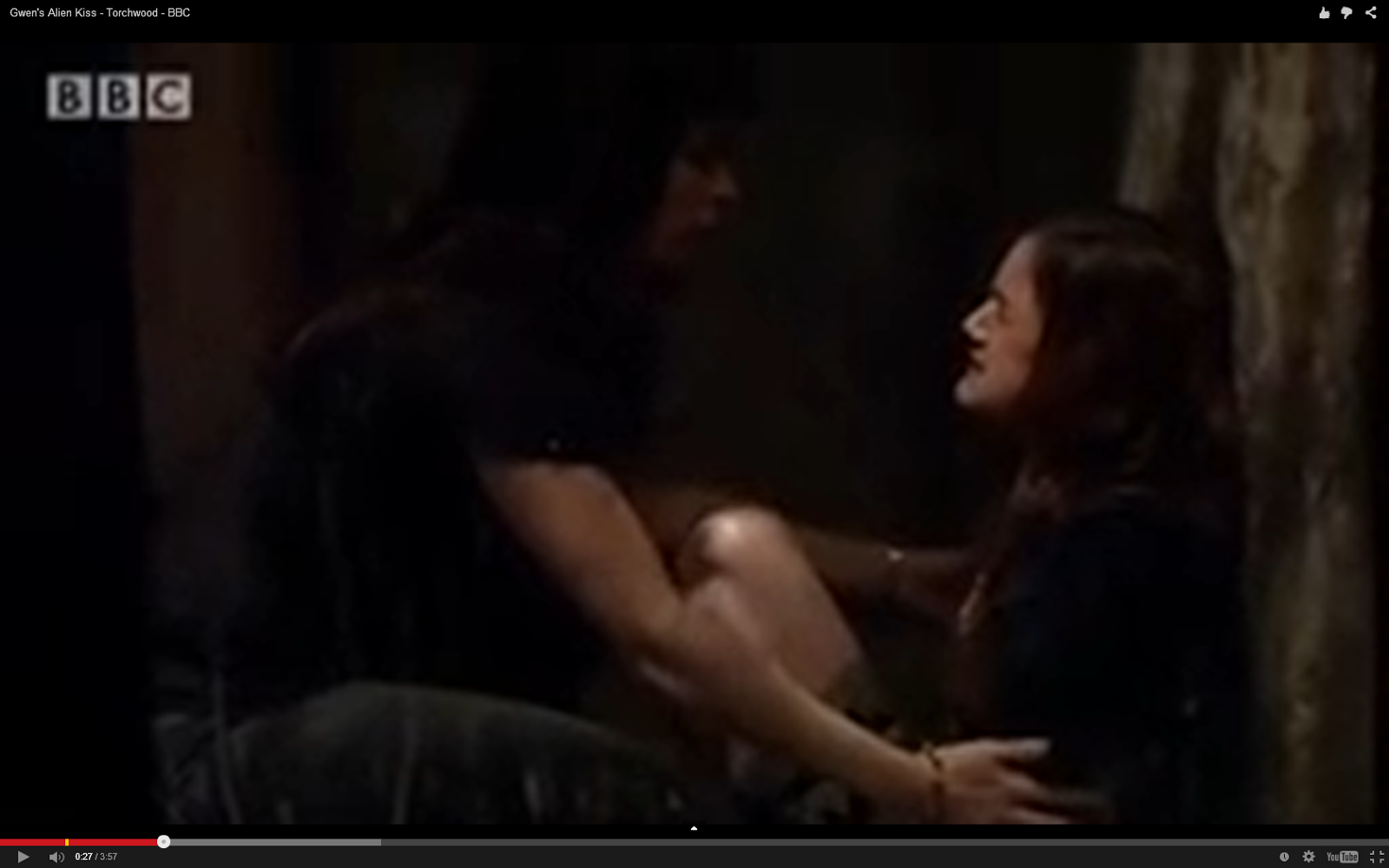
When the two-shots end, it returns to a shot-reverse-shot sequence which anchors that the moment has ended, and they are physically but also emotionally drawn apart.
There is a stereotype of the female victim (the girl with lighter hair) and also a counter-type with the central protagonist as she is helping the girl and this would normally be something that a male would do. It has become normative that men are strong and are always the ones who help the female.
Audience:
The welsh accent used shows that this program would be suited better to a welsh or British audience. This shows that the production would not be shown in America. Therefore not gaining a large amount of profit due to the Gant rule. It could be said that the male gaze (Mulvey) features when the man in the control room is watching the two girls on a screen. This is denoted through a cut to CCTV footage and then there is a cut to the man which is a close-up. This is a criticism of the male gaze, as the heterosexual man is attacked by the central protagonist who we have been firmly encouraged to identify with throughout the clip. The audience also links to the intertextual reference used in this clip:
Intertextuality:
In the first scene of the clip, there is a use of intertextuality, when the central protagonist is behind glass, it is similar to a scene in The Silence of the Lambs (Jonathan Demme, 1991). The target audience perhaps people of around 15-30, would mostly not recognize this reference. This intertextuality features for the older, secondary audience as they, as viewers would gain pleasure from seeing and noting this reference.
Stuart hall stated that semiotics had many limitations as it was assumed that all the reading resided only in the text. He argued that meaning resides also in the audience and different people react differently to viewings. if an audience follows most of what we want them to, they have had a preferred reading
If there is a sad scene and people laugh, then it is an oppositional reading.
If there is a mixture of the two, then it would be a negotiated or contested reading.


(Images: Left, The silence of the lambs, Right, Torchwood. The glass panels, especially with the holes are extremely similar)


